Key takeaways
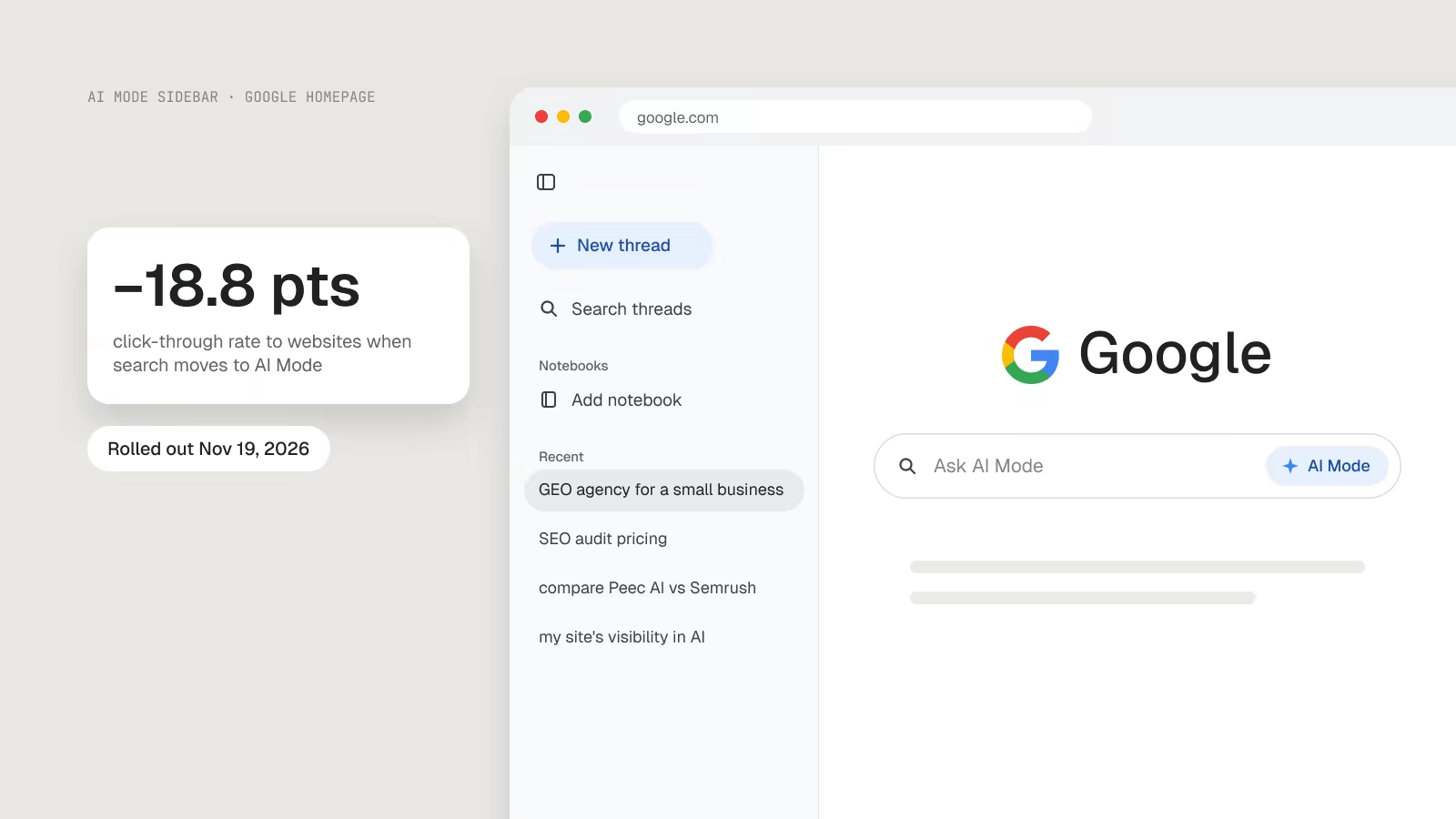
- On November 19, 2026, Google rolled out a collapsible sidebar worldwide on its desktop homepage. It lists recent AI Mode searches and lets you pick them up again.
- The sidebar has a New thread button, a thread search (Search threads), Notebooks and a Recent list. Nothing has been announced for mobile.
- Google frames it as a way to move forward on searches that can't be settled in one query. In practice, the homepage now nudges people toward long conversations in AI Mode.
- In a randomized experiment with 1,100 US users, switching to AI Mode cut the click-through rate to websites by 18.8 points (14.9 points when counted per conversation).
- In Search Console, every AI Mode follow-up is counted as a new query, and its position starts again at 1. The more follow-ups, the harder the queries report is to read.
- For a brand, the recommendation is decided on the follow-up questions (comparison, pricing, choice), and that is where you need to be cited.
On November 19, Robby Stein, VP of Product for Google Search, announced on X the global rollout of a collapsible sidebar on Google's desktop homepage. Its job is to "find and pick up your recent AI searches". The change is small, the signal much less so: Google wants people to come back to their conversations from one session to the next, as they do in ChatGPT.
We looked at what changes for a brand when a growing share of searches turns into a chat thread: where the clicks go, what Search Console still measures, and at which point in the conversation your name needs to show up.
What Google launched on November 19
The sidebar collapses against the left edge of the desktop homepage. Once opened, it shows a button to start a new thread (New thread), a field to search past threads (Search threads), a Notebooks section with "Add notebook", the list of recent searches (Recent) and access to settings.
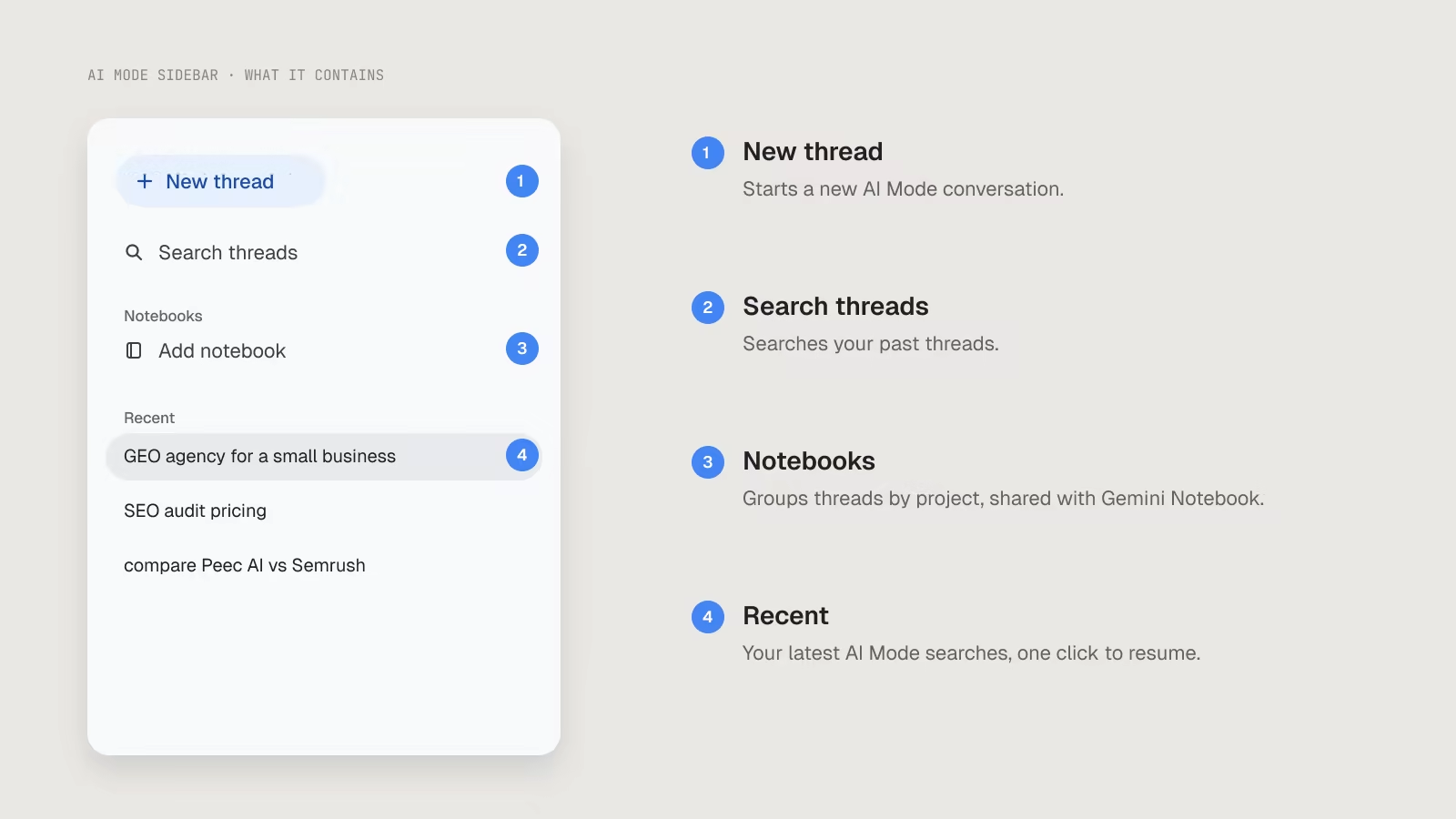
Robby Stein explains the change this way: "People are coming to Search with more questions that aren't one and done, and in testing this sidebar has really helped people make progress and keep exploring the web." Google has published no figure to back that "really helped".
The launch followed several weeks of testing. Search Engine Roundtable spotted a version of the bar on the classic results page as early as October 14, and Barry Schwartz, who had had it for three weeks, writes that it doesn't slow his searches down, even though he doesn't like the interface. At Search Engine Watch, Sachin Patel now sees it on every search.
Two announcements from the same week go with it:
- On November 17, Google opened temporary threads in AI Mode worldwide. These conversations are tied neither to history nor to personalization, so they don't appear in the sidebar.
- Notebooks group AI Mode threads by project. According to Google's help center, a notebook created in Gemini Notebook also appears in AI Mode, but the conversations themselves don't sync with the Gemini app.
For now, the sidebar only covers the desktop homepage. Google has said nothing about mobile or the Google app.
Why Google is pushing conversations over queries
The sidebar brings Google closer to the interface of a chat assistant: history on the left, a field in the middle, threads you come back to. ChatGPT and Gemini have worked this way since launch. The difference is that this time the interface sits on Google's homepage.
The audience is already there. Sundar Pichai said during the Q2 2026 earnings call that AI Mode had passed 1 billion monthly users. In France, AI Mode has been available since July 22, 2026, months after the rest of Europe because of neighboring-rights disputes.
A monthly user is not daily usage, and classic search is still the majority. But every change to the homepage shortens the distance between "I type a query" and "I pick up yesterday's conversation". The sidebar cuts that path down to one click.
What it changes for your visibility
Fewer clicks per intent
A conversation that keeps going in AI Mode sends few visitors to websites, which is the whole idea of zero-click search. The most solid study so far is a preregistered experiment by researchers at Penn and Northeastern, run in March 2026 with 1,100 US users: forcing searches into AI Mode cut the click-through rate to external sites by 18.8 points. Counting each conversation as a single search, the drop is still 14.9 points.
If the sidebar does what Google expects, a larger share of searches will happen in that setting. For a given topic, expect more intents to be settled without a visit, and visits that come later in the journey, from prospects who are already further along.
A harder Search Console to read
In Search Console, an AI Mode follow-up is a new query. Google says so in its documentation: AI Mode is "counted towards the overall data in Search Console", in the Performance report, with no filter to isolate it. And according to Search Engine Land, each follow-up question is logged there as a separate query, with its own position starting again at 1.
Hence the odd queries several analysts have been spotting since the summer: fragments like "yes go on" that make no sense outside the conversation that produced them. The more the sidebar encourages people to resume threads, the more these fragments weigh in the report, and the harder average position and CTR become to interpret. We cover this in more depth in our article on the limits of rank tracking.
Getting cited at every turn, not just the first
In a thread, the question that matters for a brand is rarely the first one. People start broad ("how do I improve my site's visibility in AI"), then narrow down: which providers, how much it costs, which one to pick for a 50-person company. That's where the recommendation is made. And each follow-up triggers its own background searches, the query fan-out mechanism: the pages cited at the third turn are not the ones cited at the first.
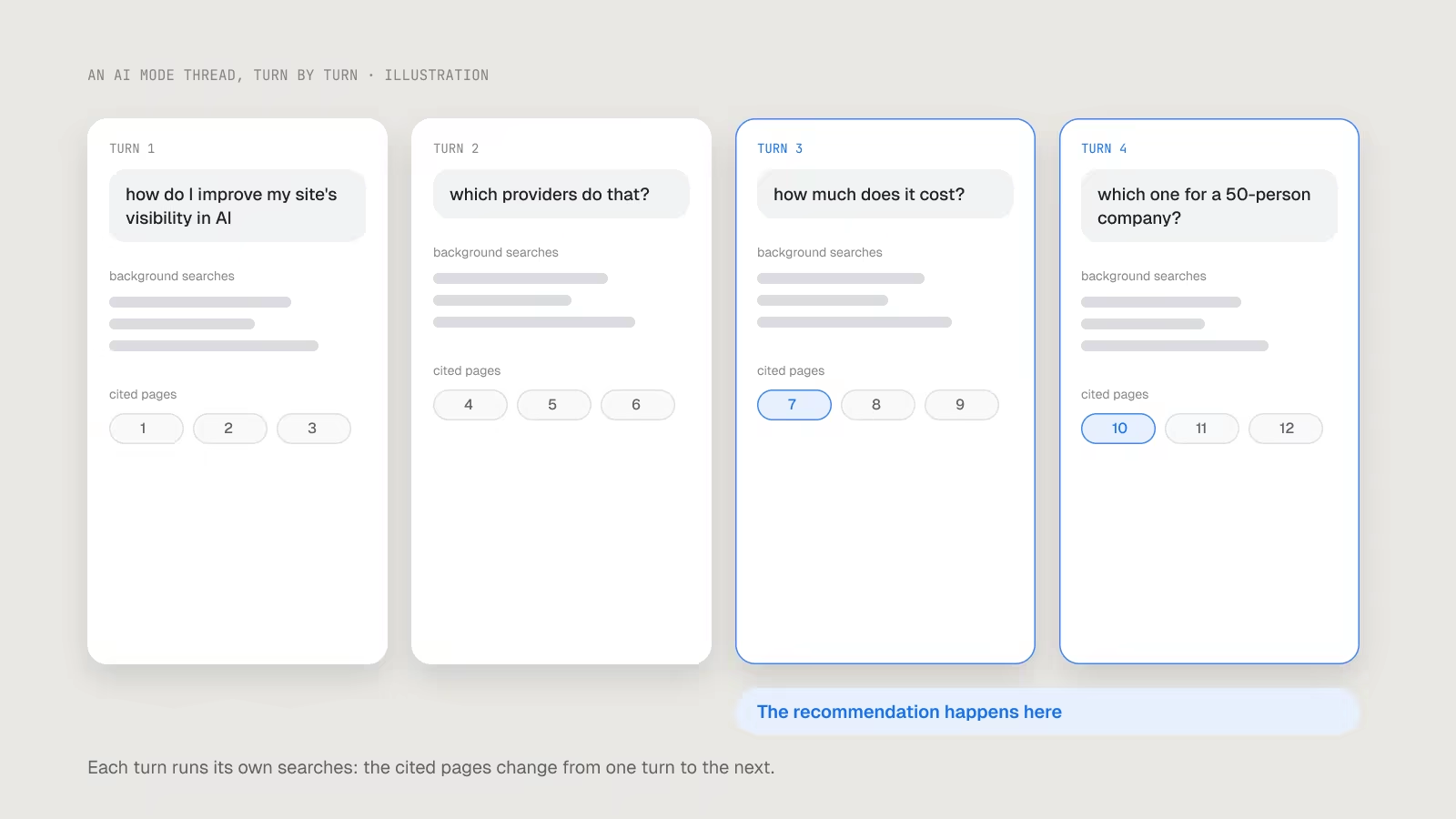
A visibility tracker that only tests the opening question misses the part of the journey where the choice is made. The same logic applies to AI citation rate: measurement has to follow the questions your prospects actually ask, in the order they ask them.
What we recommend doing now
Nothing urgent breaks on November 19. But four adjustments cost little and keep you from misreading the coming months.
- Annotate November 19, 2026 in your Search Console and GA4 reports. If your queries or CTR move in the following weeks, you'll know what to check before blaming an update.
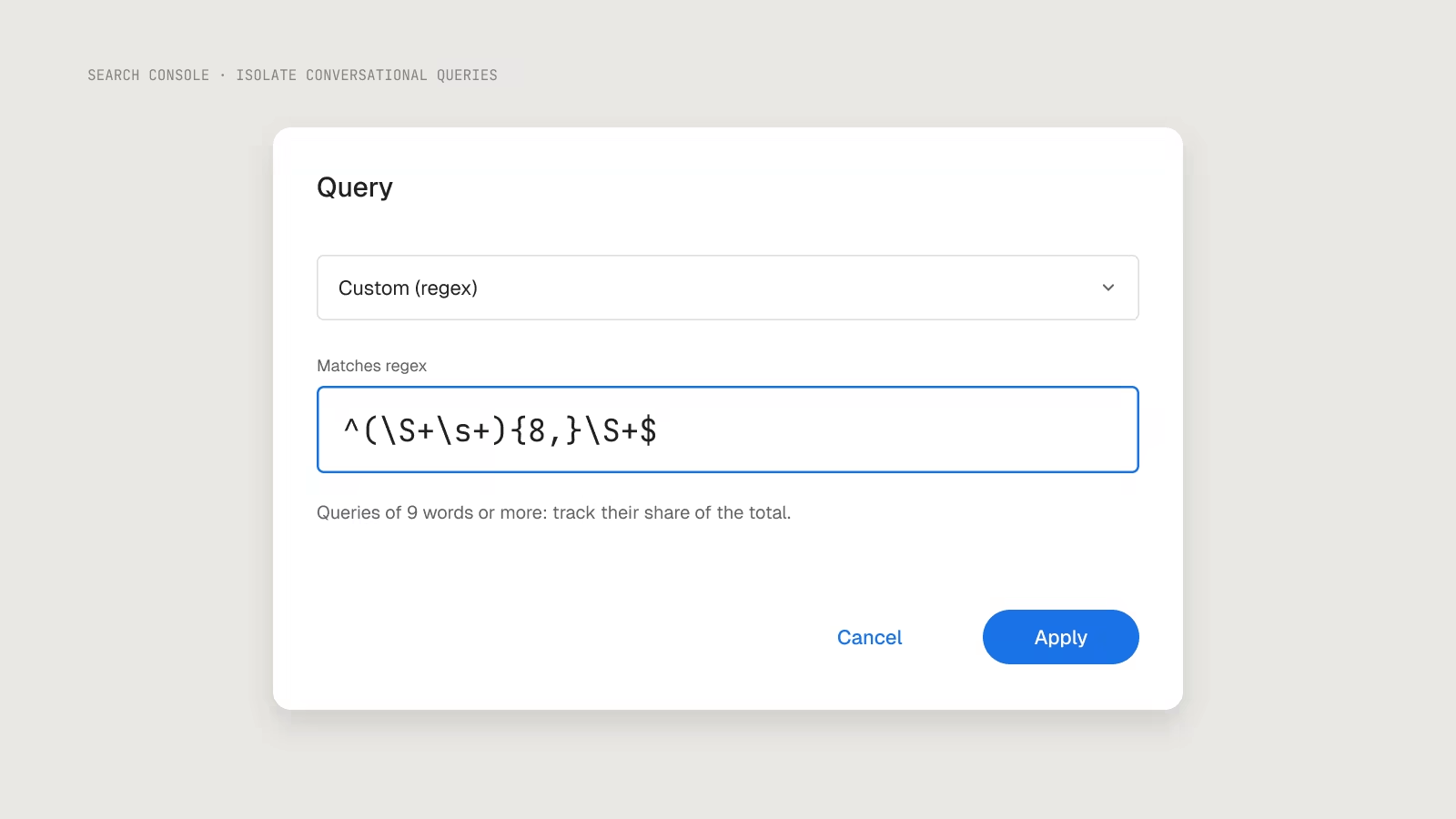
- Isolate conversational queries in Search Console. In the Query filter, choose "Custom (regex)" and paste
^(\S+\s+){8,}\S+$: you get queries of 9 words or more. Track their share of the total instead of letting them skew your averages. - Add follow-up prompts to your AI visibility tracking: comparison, pricing, choice by company size or industry, next to the generic opening question.
- Cover second and third-turn questions on your site: honest comparison pages, pricing, concrete implementation cases. Those are the passages AI Mode goes looking for when the conversation narrows.
For measuring the traffic that still comes in from AI, our method is laid out in Measuring AI traffic in GA4.
What we don't know yet
Google has published no figure on the sidebar's effect, only that it "really helped" in testing. We also don't know whether it will come to mobile, where most searches happen, or to Chrome's New Tab page. And Search Console still can't separate AI Mode from classic search.
We'll update this article when those points are settled.
Is Google's sidebar available everywhere?
Google describes the rollout as global, on the desktop homepage. Since the rollout is gradual, the sidebar may not show up on every account yet. In France, AI Mode has been available since July 22, 2026.
Can you turn the sidebar off?
It can be collapsed: when closed, it stays tucked against the left edge of the page. To keep a conversation out of your history, Google has offered temporary threads in AI Mode since November 17.
How can I tell if my traffic comes from AI Mode?
Search Console blends AI Mode and classic search in the Performance report, with no dedicated filter. Follow-ups show up as separate queries, often long or fragmentary. That's the only direct clue available today.
Should I change my SEO strategy?
Not rebuild it. Ranking on Google is still the foundation, and AI Mode draws on the same pages. What changes is where you need to be visible: on Google and in AI answers, including the questions that come after the first one.