.svg)
Same content. Stronger performance in every market.
Translating an article isn't enough. Vydera adapts search intent, local vocabulary, schema, and entities for every target market. Your brand becomes visible on every local Google and cited by every AI in the right language.
They’re accelerating their growth with Vydera.





Translation isn't localization.
A literal translation misses local search intent, native expressions, and regional entities. The result: your content exists in the target language but performs in no market — not on Google, not in AI.
40% of B2B searches are local
Search intent varies massively from country to country, even within the same language.
3× more citations when content is localized
AI engines favor content that sounds native to its market, not generic translations.
0 SEO penalty with the right technical setup
Every market has its own technical signals. Vydera implements them without duplication or cannibalization.
Before we localize, we map every market.
Our AI agents scan SERPs, local queries, and AI answers in every target country. Vydera builds the real intent map for each market — not a translated guess.
Content built for each market, not translated into it.
Every local version is produced as original content: native vocabulary, cultural references, local examples, formats AI engines in the region recognize. No mechanical translation.
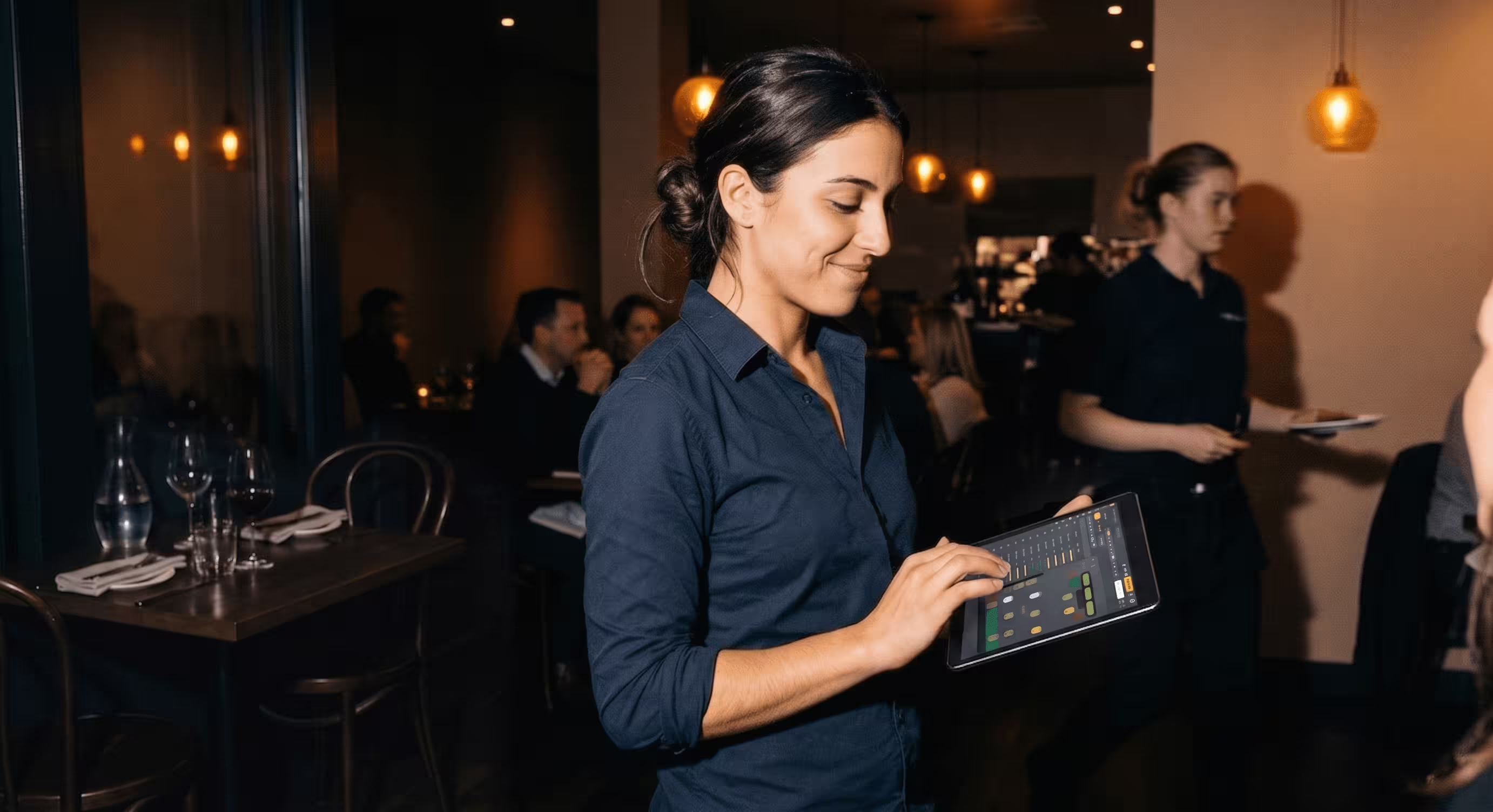
CoverManager: Website migration and localization into 5 languages

The right technical signals for every version.
Hreflang properly set, regional entities (Wikipedia FR / EN / DE, local Google Business), schema translated and adapted. Google and AI engines know which version to serve to each user.
Every market tracked independently.
Local rankings, AI citations by region, share of voice per market: Vydera monitors each version as its own site and flags the moment a market drifts off track.
6 building blocks that secure every localization.
Each block is produced by a specialized AI agent, validated by a Vydera expert, and deployed without duplicating your source content.
Intent mapping
SERP and AI scan per target market: native queries, priority angles, and competitive gaps identified.
Native production
Articles, comparisons, and FAQs written as original content in each language, not translated.
Hreflang & schema
Rigorous hreflang deployment, translated schema.org, local entities (sameAs per market).
Cultural adaptation
References, examples, currencies, formats, and proper nouns adapted to local usage.
Multi-market monitoring
Independent tracking of local Google rankings, AI citations, and share of voice per region.
Ongoing maintenance
Synchronized updates, divergence fixes, iterations driven by per-market performance.
Brands turning visibility into growth.
+65% GEO visibility in 6 months
"In 6 months, Vydera structured our visibility across Google and AI platforms. We went from challenger to #2 in the French LMS market."
 View case study
+250%organic traffic in 90 days
"In 90 days, Vydera increased our organic traffic by 3.5x. We went from an unknown challenger with no SEO footprint to a visible player on high-value wealth queries."
 View case study
Compatible with all CMS & frameworks
We work directly on your existing technical stack with no migration required. Full compatibility is guaranteed across all CMS platforms, JavaScript frameworks, and e-commerce systems.
What is your stack?
Frequently asked questions.
What is the difference between translation and localization?
Translation reproduces words, while localization reproduces intent. A literal translation keeps source-market expressions and therefore misses how people actually search locally. Vydera adapts vocabulary, cultural references, and formats so your content performs as if it were originally written for each target market.
How many languages does Vydera support?
Vydera covers the main European and North American languages: French, English, Spanish, German, Italian, Portuguese, and Dutch. AI agents are trained on the SEO and GEO specifics of each market.Additional languages are available on request with prior scoping.
How do you prevent duplicate content between language versions?
Through a strict hreflang deployment and language-specific schema.org markup. Each version explicitly declares its target language and region. This ensures Google and AI systems serve the right version to the right user without content cannibalization.
Does Vydera translate existing content or create new content?
Both, depending on strategy.
- For pillar content, we create native, market-specific versions from scratch.
- For supporting content, we adapt and localize existing source material in depth.
In all cases, each version is reviewed by a Vydera expert who understands the target market.
What impact does this have on visibility in generative AI systems?
Strong impact—if each version has its own schema and local entities. ChatGPT, Perplexity, Gemini, and Claude often provide different answers depending on query language. Vydera optimizes your brand to be cited across all language versions of AI systems, not just the original source language.
What if my internal team already writes in other languages?
We integrate into your existing workflow.
Vydera can:- Define market-specific editorial strategy
- Provide localized content briefs
- Audit internally produced content
- Or fully manage execution end-to-end
You keep control of editorial direction, while we ensure maximum visibility across markets.