.svg)

Key takeaways
- AEO is not a new SEO. It's a logical extension of quality SEO
- The fundamentals stay the same: useful, structured, trustworthy content
- What really changes: performance metrics, trust signals, and citation logic
- AEO tracking is fundamentally different from classic SEO tracking
- The real question isn't "SEO or AEO" — it's: what durable digital assets am I building?
In 2026, the same question keeps coming up in every marketing conversation: "Do we need to take AEO seriously now?"
The short answer: yes. But not for the reasons you usually hear.
AEO isn't a revolution that makes SEO obsolete. It's not a gimmick you can ignore either. It's something more nuanced: an extension of SEO best practices, made necessary by how search behavior is evolving.
The way your prospects look for information is changing fast. ChatGPT, Perplexity, Google AI Overviews — these tools are no longer niche. They're part of the buying journey. And if your brand doesn't show up there, you're absent from part of the conversation.
Here's what actually changes, and what stays the same.
What both share: the common fundamentals
Before listing differences, let's set a clear baseline.
SEO and AEO share the same core objective: making your content findable and understandable by algorithms, so it gets surfaced to humans looking for an answer.
Quality criteria are largely identical:
- Useful, factual, well-structured content
- Demonstrated expertise (E-E-A-T)
- Authority built over time
- Clean technical foundation (speed, indexation, crawlability)
This isn't a coincidence. The sources cited by ChatGPT or Perplexity are most often the same pages ranking in Google's top 10–20. To perform in AEO, you first need to perform in SEO.
What changes is the additional layer AEO adds on top.
What SEO does (and AEO inherits)
These are the foundations everything else is built on:
Technical
- Site architecture and internal linking
- Page speed and Core Web Vitals
- Indexation and XML sitemaps
- 301 redirects
- Meta tags (title, description, headings)
Content
- Keyword research and targeting
- Long-form, structured, exhaustive content on a topic
- Full semantic coverage (not just one keyword — the entire thematic field)
- Regular updates to existing content
Authority
- Quality link building (backlinks from credible sources)
- Brand reputation and online mentions
- Consistent presence across third-party platforms
Measurement
- Rankings in the SERPs
- Organic traffic (Google Search Console, GA4)
- CTR and impressions by query
What AEO adds (the delta)
This is where things get interesting.
AEO doesn't start from scratch. It requires targeted adjustments on points that classic SEO didn't fully account for.
Content specifically designed for AI extraction
- Conversational format: directly answering questions, not just targeting keywords
- Explicit, structured FAQs (AI models love question-and-answer formats)
- Short paragraphs with one idea per block — the AI needs to extract a passage without surrounding context
- Data, statistics, and expert quotes embedded in the content
- Sources cited within the body text
Structured data (Schema.org)
- Organization: so AI systems clearly identify your entity
- Article: author, date, topic — the basic credibility signals
- FAQPage: the most underrated schema, directly used by LLMs
- Product, LocalBusiness: depending on your business type
External authority and brand reputation in AI
This is the most differentiating point.
SEO values backlinks to your site. AEO values mentions of your brand in sources that AI systems consider trustworthy: specialist press, review platforms (G2, Capterra, Trustpilot), industry forums (Reddit, professional communities), expert content that cites you.
If your brand is only mentioned on your own site, AI systems don't really know you — or not well enough. When in doubt, they cite whoever they recognize.
Brand reputation is no longer just an image question. It's a direct visibility lever inside AI-generated responses.
Broader semantic coverage
LLMs don't search for your exact keyword. They break each question down into sub-queries to explore the entire thematic space (the query fan-out mechanism). Content that covers a topic in depth — not just one page per keyword — has a much higher chance of being extracted.
Topic clusters and pillar content are particularly relevant here. Writing content to be cited in AI.
Comparison table: SEO alone vs SEO + AEO
| Dimension | SEO | SEO + AEO (delta) |
|---|---|---|
| Algorithmic target | ||
| Objective | Rank in top positions | |
| Content format | Keyword-optimized pages | |
| Structured data | Recommended | Organization, Article, FAQPage |
| Authority | Backlinks to the site | |
| Performance measurement | Rankings, traffic, CTR | |
| Tracking | Google Search Console, GA4 | |
| Traffic generated | Clicks to the site | |
| Conversion quality | High volume, variable qualification |
AEO tracking: a topic of its own
This is probably where the difference is most concrete day to day.
In SEO, you have mature tools: Google Search Console tells you exactly which queries you appear for, at what position, with what CTR. Precise, continuous, free tracking.
In AEO, we're not there yet.
What to measure in AEO ?
This is probably where the difference with traditional SEO is most tangible on a day-to-day basis.
In SEO, you have mature tools: Google Search Console tells you exactly which queries you appear for, at which position, with which CTR. It's precise, continuous, free tracking.
In GEO, we're not there yet. There's no Google Search Console equivalent for AI. But the metrics to track are now clear — and they paint a very different picture from what we've been measuring until now.
Sources used
The pages AI platforms pull from to generate their responses.
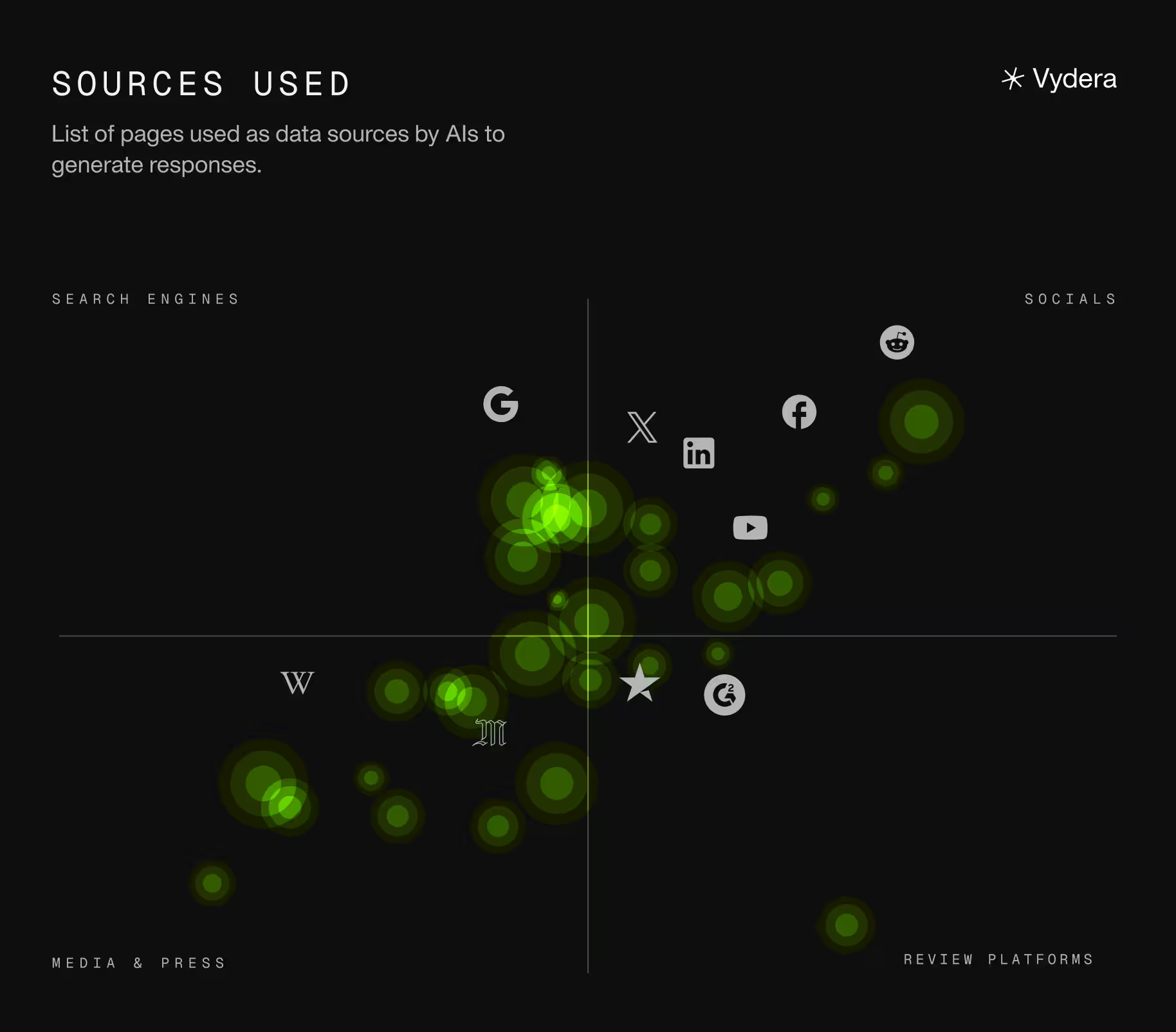
AI platforms don't all draw from the same pool.
A Profound study analyzing 680 million citations shows that ChatGPT, Perplexity, and Google AI Overviews have radically different source preferences. Wikipedia accounts for 47.9% of ChatGPT's most-cited sources, while Reddit dominates on Perplexity (46.7%) and Google AI Mode (21%). As for commercial domains (.com), they represent over 80% of all citations across platforms.
The implication for businesses is concrete: you need to understand which pages — yours, your competitors', or third-party sources like review platforms and forums — are feeding AI responses in your space. If your content isn't part of the sources being ingested, you're simply absent from the conversation.
Source rate
The percentage of AI responses that cite your website as a reference.

Beyond knowing which sources are used, you need to measure the share of your own content in the mix. That's the source rate: the proportion of AI responses that directly cite your site, relative to all sources referenced on your key queries.
This KPI matters even more given how selective AI platforms are.
ChatGPT cites an average of only 7.9 sources per response, compared to 21.9 for Perplexity.
Fewer available "slots" means fiercer competition for each citation. And the pages being cited aren't necessarily the ones ranking in SEO: 28.3% of ChatGPT's most-cited pages have zero organic visibility on Google.
The goal is to grow this rate over time by improving the structure, freshness, and credibility of your content — the signals AI platforms prioritize when deciding what to cite.
Mention frequency / Share of Voice
Compare your brand's visibility with that of key competitors over time.

This is the most strategic GEO metric. Share of Voice measures the proportion of AI responses that mention your brand compared to your competitors, across a set of prompts representative of your audience.
Unlike SEO where you can hold a fixed position 1 for a query, results here are far more volatile.
According to SparkToro (January 2026), there's less than a 1 in 100 chance that ChatGPT or Google AI will generate the exact same list of brands if asked the same question 100 times.
This isn't a fixed ranking — it's a frequency of appearance.
That's why it's important to measure this frequency regularly, across a large enough prompt universe (50 to 150 prompts per intent segment, per best practices). Weekly tracking helps detect shifts before competitors take over your key topics.
Sentiment
Assess how AI platforms perceive and present your brand.
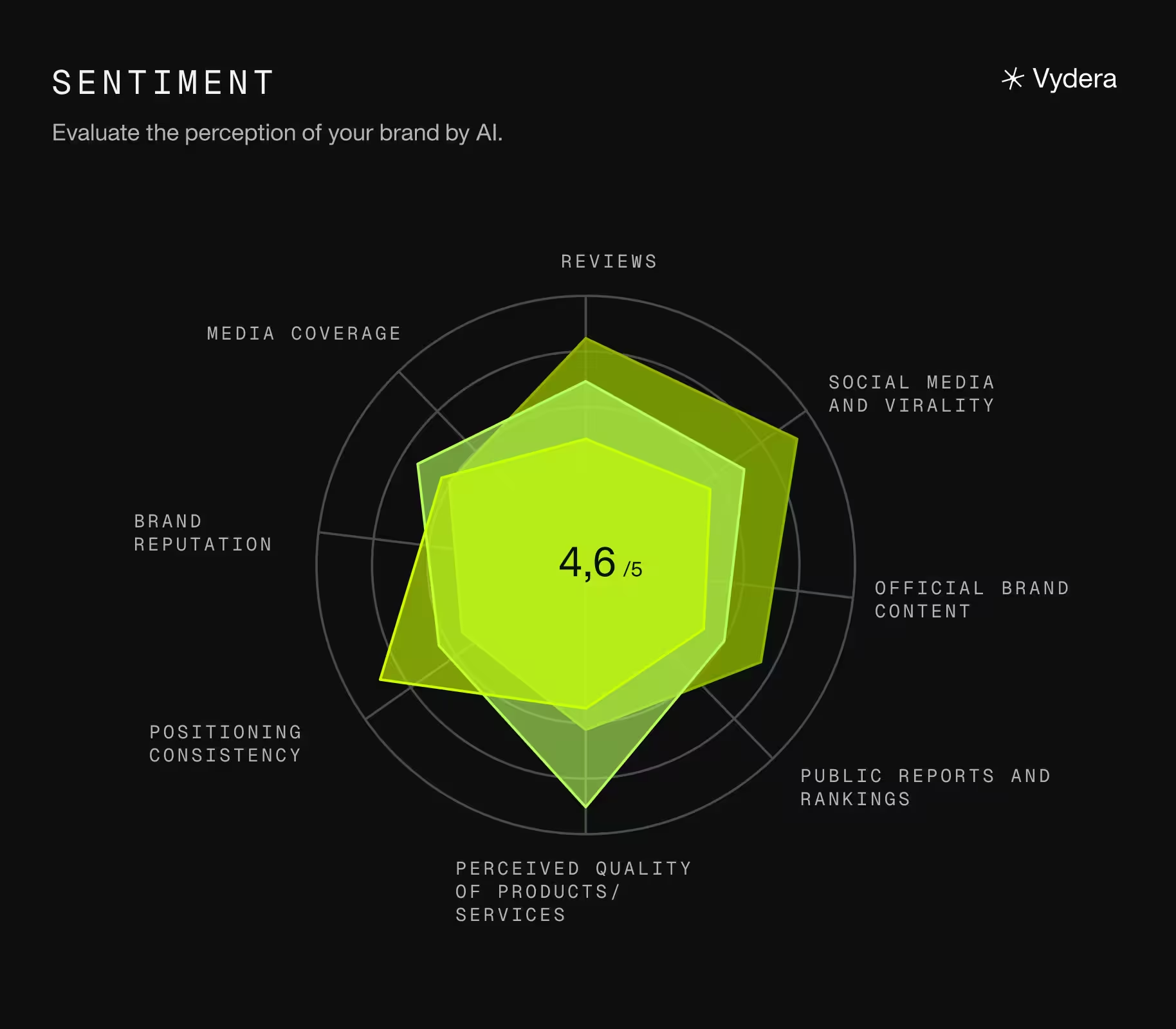
Being mentioned isn't enough — you need to know how AI talks about you. Sentiment measures whether generated responses present your brand positively, neutrally, or negatively.
This is an angle traditional SEO never really covered. In SEO, you control the messaging on your own site. In GEO, the AI synthesizes what it finds about you across dozens of sources: customer reviews, press articles, forums, comparison sites. If your online reputation is weak or inconsistent, the generated response will reflect that.
Sentiment analysis helps identify concrete issues: a negative perception on a specific aspect of your offering, outdated information persisting in responses, or a competitor being systematically better positioned than you. It also serves as an early warning signal: declining AI sentiment often precedes a drop in citations.
Visibility rate by AI platform
Average frequency of your brand appearing in each AI platform.

Not all AI platforms treat you the same way. Your brand might be highly visible on ChatGPT and completely absent from Perplexity — or the other way around.
According to an Ahrefs analysis covering 76.7 million AI Overviews and nearly one million ChatGPT and Perplexity prompts, only 7 out of the top 50 most-mentioned sites appear in the top 50 across all three platforms.
And according to Superlines, citation rates for the same brand can vary up to 46x between two AI platforms.
Why such a gap? Each AI has its own retrieval logic, preferred sources, and biases. ChatGPT relies heavily on Bing results and favors encyclopedic content. Perplexity prioritizes freshness — 76.4% of its most-cited pages were updated within the last 30 days. Google AI Overviews pulls from its own index and favors high domain authority content.
Tracking visibility by platform helps you know where to focus your efforts and avoid a blind spot: believing you're "visible in AI" when you're only showing up on a single platform.
Average position
Average citation position of your brand in AI responses, compared to competitors.
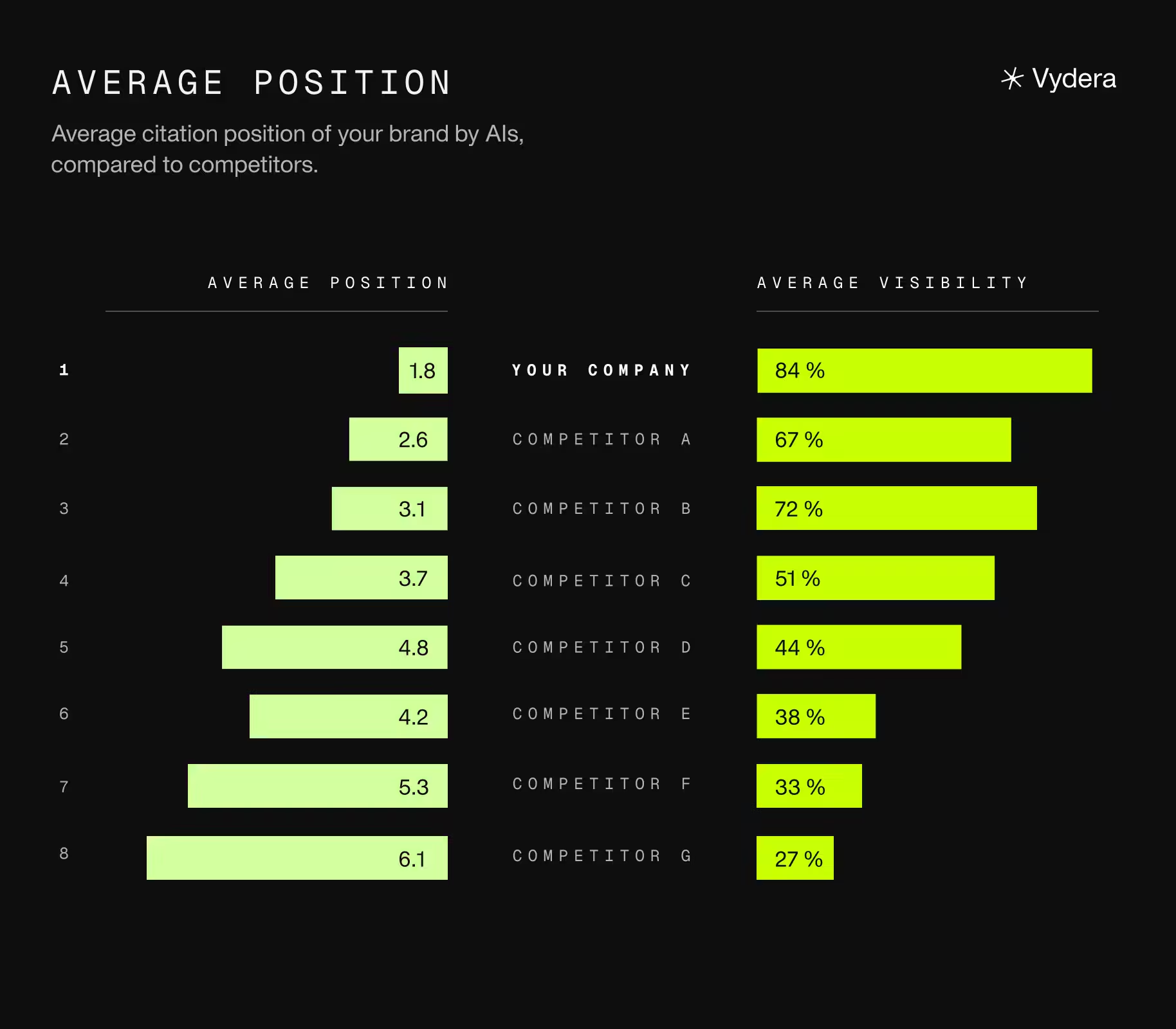
When an AI generates a response and cites multiple brands, the order they appear in matters. The first brands mentioned capture more attention and are perceived as more credible — an effect similar to position bias in SEO, but within a conversational format.
Average citation position measures where your brand typically ranks in AI responses compared to your competitors. A strong Share of Voice isn't enough if you're consistently cited last. Conversely, a high position even with moderate frequency can signal that AI platforms see you as a go-to authority in your space.
What influences this position: entity density (how clearly AI platforms identify your brand), the quality and recency of your content, and above all your perceived authority in third-party sources.
According to an SE Ranking study of 2.3 million pages, domain traffic is the factor most correlated with AI citations (SHAP value of 0.63), far ahead of traditional SEO signals.
How to track today?
There's no Search Console equivalent for AI systems. Specialized tools fill that gap — with varying levels of maturity.
The basic method often remains manual: regularly testing representative prompts in ChatGPT, Perplexity, and Gemini. Observing whether you appear. Documenting over time.
To go further, tools like Meteoria, Otterly, or Peec AI automate this tracking and give you a competitive comparison.

👉 We've published a full comparison: The 10 best AEO tools to track your AI visibility in 2026
A figure that puts things in perspective:
Only 6% of sources are shared between ChatGPT and Perplexity for the same prompt.
Being visible on one doesn't guarantee visibility on the other. Multi-platform tracking becomes necessary to get a real picture of your AI presence.
The real question: what digital assets are you building?
The "SEO vs AEO" debate is legitimate. But it risks missing a more structural question.
Search behaviors are evolving fast. Search engines are adapting just as quickly. What's true today about AI may not be true in 18 months.
What remains true regardless of how things evolve:
Quality content, well-structured, that genuinely answers your audience's questions, will stay relevant. A brand recognized and cited in trustworthy sources will continue to be a legitimate source. Real expertise, documented and visible online, doesn't go out of date.
SEO and AEO are disciplines. Digital assets — your content, your reputation, your thematic authority — are what lasts.
The goal isn't to "do AEO." It's to build a robust digital presence, capable of surviving the next algorithmic changes, whatever they turn out to be.
Our take at Vydera
AEO is a necessary extension of SEO. Not a revolution, not a replacement.
What we see with our clients: those who were already doing solid SEO have less work to do for AEO. Content quality, structure, authority — it all transfers. The delta to close is mainly around format, structured data, and external reputation.
What seems underestimated: brand reputation inside AI systems. Many companies are absent from AI responses not because their site is poorly optimized, but because their brand isn't mentioned enough in third-party sources that LLMs recognize as trustworthy. That's a real project, different from classic SEO link building.
And tracking remains the main pain point. We don't yet have the tools SEO took 15 years to develop. That has to be accepted and worked with.
Conclusion
SEO and AEO don't oppose each other. They complement each other.
SEO remains the foundation. AEO is the additional layer that current search behaviors make necessary. And above both, the real priority stays the same: create quality, durable digital assets that withstand algorithmic change.
The question isn't "which one to choose." It's "am I building something that will last?"
Want to know how your brand appears in AI responses? Or build a coherent SEO/AEO strategy for your sector?
Will AEO replace SEO?
No. Sources cited by AI systems are generally those already ranking well on Google. Solid SEO remains the foundation of AEO.
What tools should I use to track AEO visibility?
There's no Search Console equivalent for AI yet. The most widely used tools in 2026: Meteoria, Otterly, Peec AI for automated monitoring. To start, regular manual tests in ChatGPT and Perplexity are enough.
Where to start if you've never done AEO?
With an AI visibility audit: test how your brand appears (or doesn't) in AI responses on your key queries. From there, the priorities are usually: structured data, structured FAQs, and external reputation.
Is AEO traffic measurable?
Partially. AI systems often generate zero-click interactions. AEO performance is therefore measured more in citations and Share of Voice than in direct traffic.
Is AEO relevant for every business?
Yes, but to varying degrees. B2B companies and sectors where prospects do informational research before buying are particularly affected.